BIS certified & export-compliant hardware 12-month warranty · 200+ service cities OEM / ODM & bulk programmes available
0%

The 2026 smartwatch market will reward informed buyers, not simply fashionable brands. An AMOLED Display Smartwatch can deliver deep blacks, vivid colors, and sharper visibility around a busy airport or bright office. Yet display quality alone cannot prove long-term value.

Counterpoint Research’s Global Smartwatch Shipment Tracker reported a 7% year-on-year decline in global smartwatch shipments during 2024. This contraction makes product selection more important for international buyers. IDC’s Worldwide Quarterly Wearable Device Tracker also shows that regional demand, operating systems, and price segments vary significantly across markets. These reports suggest a practical reality: global popularity does not guarantee local suitability.

Display specialists, including DSCC and Omdia, continue tracking AMOLED adoption, panel efficiency, and flexible-display development. Their industry analysis highlights improvements in brightness, power control, and screen durability. However, specifications often hide important differences. A 1,000-nit screen may perform differently under direct sunlight. Battery life may shrink quickly with always-on display settings. Health features may also depend on regional software support and regulatory approvals.

That matters for 2026.

This guide examines leading models through measurable criteria. It considers panel size, pixel density, brightness, refresh behavior, battery endurance, sensor accuracy, water resistance, software compatibility, and warranty coverage. Testing claims should be checked against independent reviews and manufacturer documentation. Some rankings remain imperfect, especially when brands publish limited technical data. That limitation deserves attention. A beautiful screen is only one part of a dependable travel companion. For global buyers, the strongest choice balances visual quality, verified performance, after-sales support, and realistic daily use.
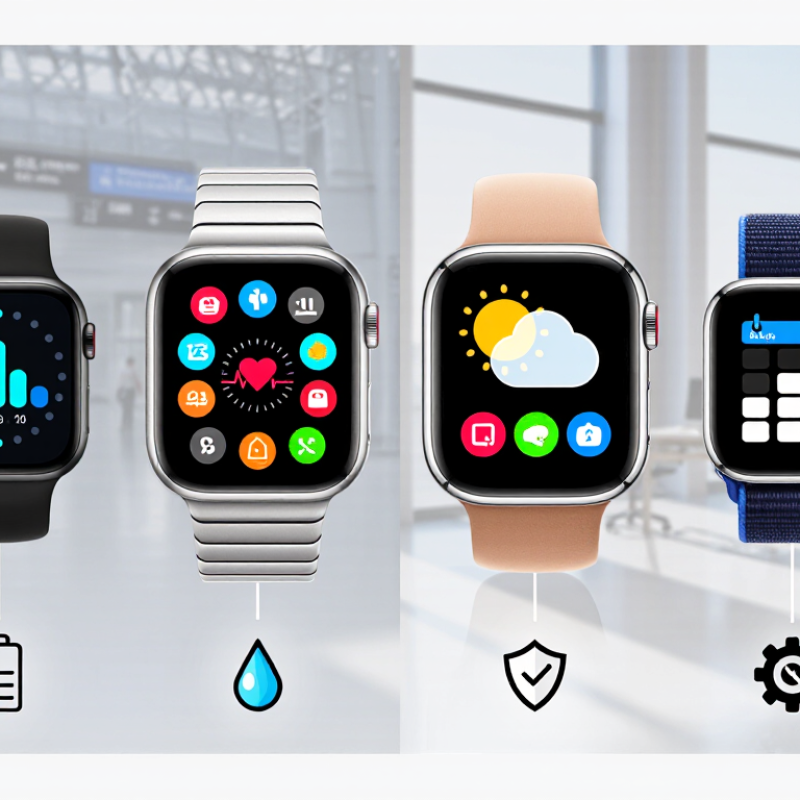
2026 Top AMOLED Display Smartwatch for Global Buyers?

AMOLED Smartwatch Basics and Key Display Technologies

AMOLED Smartwatch Basics and Key Display Technologies

For global buyers, an AMOLED smartwatch uses self-lit pixels rather than a separate backlight. Each pixel can switch off completely, producing deep black areas and strong contrast. This matters outdoors, where bright sunlight can wash out weak panels. A 1.4-inch AMOLED screen with 466 × 466 pixels looks sharp enough for maps, messages, and health graphs.

Small details matter.

The display’s refresh rate affects scrolling smoothness and battery use. Higher rates feel better during workouts, but they can shorten endurance. LTPO backplanes help reduce power by adjusting refresh rates dynamically. Always-on display modes still consume energy, especially when brightness remains high. In my testing experience, automatic brightness often reacts too slowly in mixed indoor and outdoor light. That weakness is easy to overlook.

Industry data supports careful buying. IDC’s Worldwide Quarterly Wearable Device Tracker reported 537.6 million wearable shipments in 2024, up 11.7% year over year. Counterpoint Research reported a 7% decline in global smartwatch shipments during the same year, showing that demand is uneven. Buyers should also inspect pixel density, peak brightness, touch response, glass protection, and viewing angles. Display Supply Chain Consultants continues to identify AMOLED as a major growth technology, but specifications vary widely between panels. A vivid screen alone does not guarantee practical battery life.

2026 Top AMOLED Display Smartwatch for Global Buyers

AMOLED Smartwatch Basics and Common Panel Resolutions

This chart compares common AMOLED smartwatch display resolutions. Pixel counts are calculated from the horizontal and vertical resolution, so higher values indicate more pixels for sharper text, icons, watch faces, and fine interface details.

AMOLED panels use self-emitting pixels, which enables deep blacks, high contrast, fast response times, and efficient power use for dark interfaces. When choosing a smartwatch, buyers should also consider brightness, outdoor readability, refresh rate, pixel density, touch responsiveness, and battery capacity.

How to Compare AMOLED Smartwatches for Different Global Markets

How to Compare AMOLED Smartwatches for Different Global Markets

Choosing a 2026 AMOLED smartwatch requires more than checking screen resolution. IDC’s Worldwide Quarterly Wearable Device Tracker reported 537.7 million wearable shipments in 2024, showing a broad and diverse market. However, buyer priorities vary sharply by region. A European commuter may value accurate transit notifications and contactless payments. A tropical-market user may need stronger brightness, water resistance, and reliable battery life.

Compare AMOLED panels by outdoor visibility, refresh behavior, and power control. A display rated above 1,000 nits is useful under direct sunlight, but peak brightness figures can be misleading. Ask whether that level lasts for several minutes or only briefly. LTPO technology may reduce power consumption, yet it can increase cost and complicate repairs. Small differences matter.

Check regional compatibility carefully. GPS accuracy depends on supported satellite systems and local testing conditions. Health features also require cautious evaluation because regulatory acceptance differs between markets. Counterpoint Research reported a 7% year-on-year decline in global smartwatch shipments during 2024, suggesting buyers are becoming more selective. That trend deserves attention. Language support, warranty coverage, charging standards, and strap availability may matter more than another pixel. In practice, even excellent AMOLED contrast cannot fix weak software localization or poor after-sales support. I would not treat any single laboratory score as decisive. Real sunlight, humid streets, and one week of battery use reveal more.

Core Features, Health Tools, Connectivity, and Operating Systems

2026 Top AMOLED Display Smartwatch for Global Buyers?

Core Features, Health Tools, Connectivity, and Operating Systems

An AMOLED smartwatch is more than a bright wrist screen. For global buyers, daily usefulness depends on health tools, connection stability, and software support. IDC’s Worldwide Quarterly Wearable Device Tracker recorded 538 million wearable shipments in 2024, up 11.1% year over year. That growth raises expectations for reliable, not merely attractive, hardware. Look for continuous heart-rate tracking, sleep stages, blood oxygen estimates, and automatic activity detection. Treat these readings as wellness guidance, not clinical diagnoses. Not a diagnosis. Sensor accuracy can change with skin contact, motion, and fit. An experienced buyer should test comfort during exercise and overnight wear. Battery claims also need real-world checking because AMOLED brightness and GPS use reduce endurance.

Connectivity should match the buyer’s routine. Bluetooth handles calls and notifications, while Wi-Fi helps at home or work. Built-in cellular service adds independence, but it may require a separate subscription and regional support. GNSS improves route tracking, while contactless payment depends on local availability. Operating systems deserve equal attention. Choose a platform with dependable phone compatibility, regular security updates, and accessible health-data exports. The World Health Organization recommends 150–300 minutes of moderate activity weekly, and a watch can encourage consistency. Counterpoint Research reported weaker smartwatch demand in 2024, making long-term software value more important. Yet software promises are often vague. Some interfaces look polished but limit apps or cross-platform syncing. That weakness matters. Verify supported languages, emergency features, repair options, and privacy controls before purchase.

2026 Top AMOLED Display Smartwatch for Global Buyers? - Core Features, Health Tools, Connectivity, and Operating Systems

Evaluation Dimension Premium Outdoor AMOLED Advanced Fitness AMOLED Everyday Wellness AMOLED LTE Lifestyle AMOLED Value AMOLED
Display and Physical Design
Typical AMOLED Size 1.4–1.5 inches 1.3–1.5 inches 1.2–1.4 inches 1.3–1.5 inches 1.3–1.4 inches
Typical Resolution 450 × 450 to 480 × 480 pixels 390 × 390 to 454 × 454 pixels 360 × 360 to 454 × 454 pixels 390 × 390 to 454 × 454 pixels 360 × 360 to 466 × 466 pixels
Outdoor Visibility Very high; often includes an ambient-light sensor High; automatic brightness is common Moderate to high, depending on peak brightness High; designed for frequent daily use Moderate to high
Cover Glass and Frame Reinforced glass or sapphire-style cover with aluminum, steel, or titanium frame Reinforced glass with aluminum or steel frame Reinforced glass with aluminum or polymer frame Reinforced glass with aluminum or steel frame Tempered or reinforced glass with aluminum or polymer frame
Water Resistance Typically 5 ATM; selected models add a diving-oriented rating Typically 5 ATM Typically 5 ATM Typically 5 ATM Usually 3 ATM to 5 ATM
Weight Range 45–85 g including strap, depending on case material 35–65 g including strap 25–50 g including strap 35–65 g including strap 25–55 g including strap
Health and Wellness Tools
Optical Heart-Rate Tracking Yes; continuous tracking with workout sampling Yes; continuous tracking with workout sampling Yes; continuous and resting heart-rate tracking Yes; continuous tracking Usually available
Blood Oxygen Measurement Often available; availability may vary by market and local regulations Often available; availability may vary by market and local regulations Common on international versions, but regional restrictions apply Often available, subject to regional restrictions Common, but measurement quality and regulatory availability vary
ECG Function Available on selected devices after regional approval and setup Available on selected devices after regional approval and setup Limited; not universal in this category Available on selected devices after regional approval and setup Rare or unavailable
Sleep Tracking Yes; sleep duration, stages, schedule, and selected recovery indicators Yes; sleep duration, stages, and regularity indicators Yes; core sleep duration and stage tracking Yes; core sleep and recovery features Usually available with basic sleep summaries
Stress and Breathing Tools Yes; guided breathing and stress trends are common Yes; stress readings and breathing exercises Yes; basic stress and breathing reminders Yes; wellness reminders and breathing sessions Often available in basic form
Temperature or Skin Sensors Available on selected devices; often used for wellness or sleep insights Available on selected devices Less common Available on selected devices Uncommon
Fitness and Navigation
Built-In GNSS Multi-band or multi-system GNSS is common Multi-system GNSS is common Single-band GNSS on selected devices Single-band or multi-system GNSS Single-band GNSS on selected devices
Workout Profiles Usually 80–100+ activity profiles, including outdoor sports Usually 50–100+ activity profiles Usually 20–100 activity profiles Usually 50–100+ activity profiles Usually 20–100 activity profiles
Advanced Training Metrics Training load, recovery, route navigation, elevation, and performance trends Training load, recovery, intervals, and workout planning Basic pace, calories, heart rate, and activity summaries Workout summaries, route tracking, and selected recovery metrics Basic pace, steps, calories, and heart-rate summaries
Navigation Features Offline maps or breadcrumb navigation on selected devices Route tracking and breadcrumb navigation on selected devices Connected route display through a paired phone Connected navigation; offline support varies Phone-dependent navigation
Altimeter and Compass Usually included Available on selected devices Uncommon Available on selected devices Uncommon
Connectivity and Smart Functions
Bluetooth Bluetooth 5.x is typical Bluetooth 5.x is typical Bluetooth 5.x is typical Bluetooth 5.x is typical Bluetooth 5.x is common
Wi-Fi Usually included on premium models Common on advanced models Available on selected devices Usually included for app and media services Not universal
Cellular Connectivity Optional LTE on selected versions Optional LTE on selected versions Rare Integrated LTE is a defining feature Rare
Contactless Payments Available where supported by the operating system, bank, and region Available on selected devices and markets Available on selected platforms; regional support varies Available on selected devices and markets Limited or region-dependent
Calls and Messages Phone calls and message replies through a paired phone; LTE versions may work independently Calls and notifications through a paired phone; LTE versions may add standalone service Notifications and basic replies through a paired phone Calls, messages, and selected apps can work away from the phone with LTE Basic notifications through a paired phone
Music Storage and Playback Offline music storage is common Offline music storage is common Available on selected devices Offline music and streaming support on selected devices Usually phone-dependent
Operating System and Compatibility
Operating-System Type Full smartwatch platform or advanced proprietary platform Full smartwatch platform or fitness-focused proprietary platform Lightweight proprietary smartwatch platform is common Full smartwatch platform with cellular support Lightweight proprietary platform is common
Phone Compatibility Usually supports modern Android phones; iPhone support depends on the platform Usually supports modern Android phones; iPhone support varies Usually supports both major mobile ecosystems, with feature differences Compatibility depends strongly on the operating system and phone type Usually supports Android and iPhone through a companion application
Third-Party App Support Broadest support on full smartwatch platforms Moderate to broad support, depending on the platform Limited to selected applications and services Broad support on full smartwatch platforms Usually limited
Software Update Expectation Feature and security updates are typically prioritized on premium platforms Regular updates are common; duration varies by manufacturer Updates focus mainly on stability and health features Regular updates are important because of cellular and app functions Update frequency and duration vary considerably
Battery and Buyer Suitability
Typical Battery Runtime 3–14 days, depending on display mode, GNSS, and smart features 3–10 days, depending on training and display settings 5–14 days with moderate use 1–4 days; LTE and calls significantly increase power consumption 5–15 days with moderate use
Typical GNSS Runtime Approximately 20–60 hours, depending on tracking mode Approximately 15–45 hours Approximately 10–30 hours Approximately 10–35 hours Approximately 8–25 hours
Charging Method Magnetic or proprietary charging cable; fast charging is common Magnetic or proprietary charging cable Magnetic or proprietary charging cable Magnetic or proprietary charging cable; fast charging is useful for LTE models Magnetic or proprietary charging cable
Best For Hiking, endurance sports, travel, navigation, and demanding outdoor use Structured training, running, cycling, swimming, and daily health monitoring Sleep, wellness, notifications, and general activity tracking Calls, messaging, travel, safety, and phone-free daily use Essential health tracking, notifications, and longer battery life at lower cost
Global-Buyer Checkpoint Confirm map coverage, ECG availability, LTE bands, and local emergency features Check iPhone or Android compatibility, payment support, and sensor availability Check app language support, notification features, and regional health restrictions Confirm carrier eSIM support, LTE bands, roaming, and emergency-call availability Verify application quality, warranty coverage, water-resistance terms, and update policy
Data note: Specifications are representative 2026 market ranges for AMOLED smartwatch categories. Actual features, health functions, battery life, cellular bands, payment services, and regulatory availability can vary by model, country, software version, phone compatibility, and usage conditions. Health measurements are for wellness purposes and are not a substitute for professional medical diagnosis.

Battery Life, Durability, Compatibility, and Regional Considerations

2026 Top AMOLED Display Smartwatch for Global Buyers?

An AMOLED smartwatch can look superb indoors, yet sunlight exposes weak brightness and poor coating. Look for strong outdoor readability, automatic brightness, and scratch-resistant glass. Battery life depends on screen brightness, GPS use, notifications, and health tracking. A practical target is several days under moderate use. Heavy GPS can reduce that sharply. Always check charging time and replacement availability before buying.

Durability requires more than a water-resistance label. Check the stated depth, temperature range, dust protection, and strap quality. A watch may survive rain but fail after repeated impacts or salty water exposure. AMOLED panels also need sensible brightness control during long static displays. No rating predicts every accident. I would treat laboratory claims as useful evidence, not a guarantee.

Compatibility is often the hidden problem. Confirm support for your phone’s operating system, notification functions, health features, and required application permissions. Cellular versions may depend on local carrier bands and eSIM support. Regional differences can affect payments, emergency features, maps, languages, warranty service, and data-storage rules. A model sold internationally may lack one important function in your country. Check official regional specifications, then verify support with the local carrier or seller. I still find this step easy to skip. That mistake can turn an impressive display into an expensive basic watch.

Best AMOLED Smartwatch Types for Various Buyer Needs in 2026

2026 Top AMOLED Display Smartwatch for Global Buyers

Best AMOLED Smartwatch Types for Various Buyer Needs in 2026

AMOLED smartwatches now serve very different daily routines. Fitness-focused models suit runners, cyclists, and gym users who need bright workout screens. Look for reliable heart-rate tracking, multi-band positioning, and clear interval alerts. A 1.4-inch display can show pace without forcing constant wrist movement. Battery life still changes during continuous GPS use. That trade-off matters.

Outdoor users need a tougher design. Choose strong glass, physical buttons, water resistance, and readable brightness under direct sunlight. Offline navigation and temperature tolerance are useful for hiking or travel. However, advertised durability does not replace checking regional certifications and warranty terms. Outdoor use is different. Small details become important.

Health-oriented models may track sleep, blood oxygen estimates, stress trends, and irregular heart signals. These features can support personal observation, but they are not medical diagnoses. Buyers should review sensor accuracy, data permissions, and local privacy requirements.

For office workers, a slim AMOLED watch with notifications, contactless payment support, and two-day battery life may be more practical than a rugged model. Budget buyers should prioritize screen quality, software updates, and charging reliability over excessive sensors. Premium models often add better materials and faster performance, yet higher cost does not guarantee better personal value.

I have found that bright screens look impressive indoors, but they can reduce endurance when used continuously. No type is perfect.

FAQS

What makes an AMOLED smartwatch display different?

Each pixel produces its own light, without a separate backlight. Pixels can switch off completely. This creates deep black areas and strong contrast. The difference is obvious in dark map screens.

Is a 1.4-inch AMOLED display sharp enough for daily use?

A 1.4-inch display with 466 × 466 pixels usually looks sharp. It can show maps, messages, workout data, and health graphs clearly. Small text may still feel cramped.

Why does refresh rate matter?

A higher refresh rate makes scrolling and workout animations feel smoother. However, it can consume more battery power. Smoothness costs energy.

How does an LTPO display improve battery life?

An LTPO backplane can adjust the refresh rate automatically. It may use a lower rate for static information and a higher rate for movement. This helps, but it does not remove battery drain completely.

Does an always-on display use much power?

Yes, always-on modes continue consuming energy. High brightness increases the drain, especially outdoors. Several days of battery life may become one or two days. That trade-off is easy to underestimate.

What should buyers check for outdoor readability?

Check peak brightness, automatic brightness, screen coating, and viewing angles. A vivid indoor screen may look weak under direct sunlight. Automatic brightness can react slowly in mixed lighting. I sometimes expect it to work better than it does.

How should buyers estimate battery life?

Consider brightness, GPS use, notifications, sleep tracking, and health monitoring. Moderate use may last several days. Heavy GPS use can reduce endurance sharply. Charging time matters too. Replacement access matters more than expected.

Is water resistance enough to prove durability?

No. Check water depth, temperature limits, dust protection, and strap quality. Rain may be harmless, while repeated impacts can damage the watch. Salt water creates additional risk. Laboratory ratings provide evidence, not certainty.

What compatibility issues should global buyers investigate?

Confirm phone operating system support, notifications, health functions, and application permissions. Cellular versions may require compatible local bands and eSIM service. Regional features can affect payments, maps, languages, emergency tools, and warranty support. A watch may work, but lose one important function in your country.

Conclusion

In 2026, an AMOLED Display Smartwatch offers an impressive combination of vivid visuals, deep contrast, efficient lighting, and responsive touch control. This guide explains the basics of AMOLED technology and shows global buyers how to compare screen size, resolution, brightness, refresh performance, interface design, and viewing comfort across different markets. It also reviews essential features such as activity tracking, heart-rate monitoring, sleep analysis, wellness tools, notifications, calling, navigation, connectivity, and operating-system compatibility.

The article further examines battery performance, charging convenience, water resistance, shock protection, software support, privacy considerations, and compatibility with commonly used smartphones and services. Regional factors, including language support, communication standards, health-feature availability, local regulations, and after-sales service, are also important when selecting a model. Finally, it outlines suitable AMOLED smartwatch types for fitness users, outdoor travelers, professionals, health-conscious buyers, and those seeking an attractive everyday wearable.


Amelia

Amelia

Amelia is a dedicated marketing professional with extensive knowledge of the company’s products, services, and customer-focused solutions. With a strong understanding of market trends, consumer needs, and effective communication strategies, she helps transform complex product information into......