Wireless Neckband Earphones remain relevant for buyers who value stable fit, physical controls, and long listening sessions. Their behind-the-neck band can feel more secure during commuting or light exercise. It also leaves earbuds easy to reach between calls. Small details matter: microphone clarity on a noisy street, cable flexibility, and whether buttons work with gloves.
Industry data offers useful context, but it needs careful interpretation. Bluetooth SIG’s 2024 Market Update forecasts annual Bluetooth device shipments rising from about 5 billion in 2023 to 7.5 billion by 2028. This covers many device categories, not neckband earphones alone. Grand View Research’s wireless-headphones market analysis also tracks broader demand, rather than neckbands as a separate product class. These reports signal a growing connected-audio market; they do not prove that every neckband segment is growing at the same rate.
For global buyers, choosing a manufacturer means looking beyond a glossy product photo. Compare battery-test methods, Bluetooth performance, microphone samples, material specifications, and documented quality-control processes. Ask how the supplier handles sample revisions, production consistency, packaging, and after-sales support. Request evidence, not just claims. A polished sample can still hide uneven buttons or weak strain relief. That is easy to miss.
This guide examines manufacturers through practical sourcing questions, product capability, and export readiness. No single factory fits every market. Buyers should verify each claim against samples and current documents before placing an order.
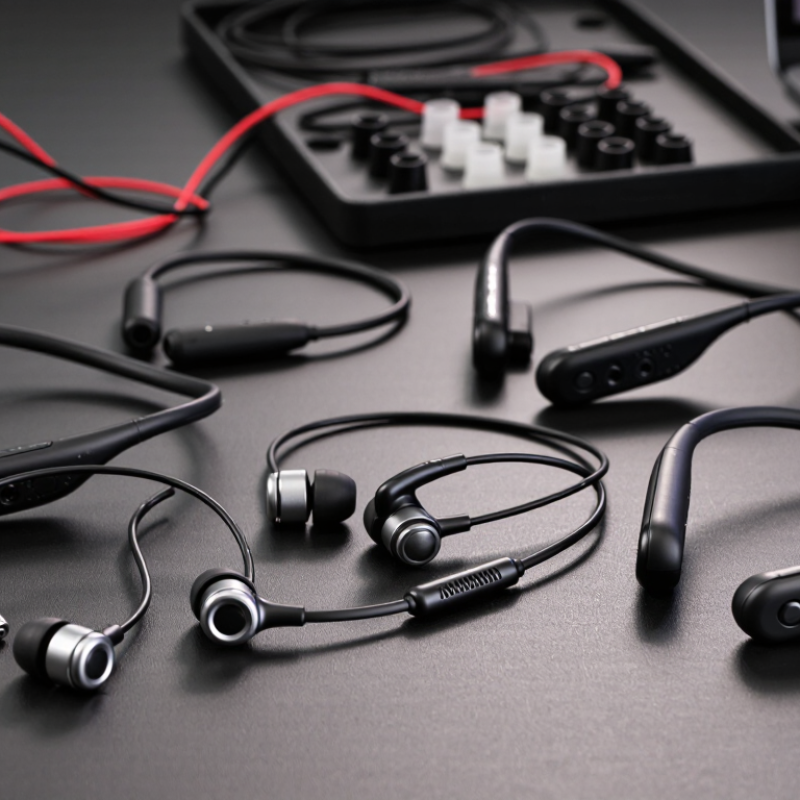
Wireless neckband earphones connect to a phone or computer through Bluetooth, a short-range radio link. A flexible band rests around the neck and keeps the battery, wireless components, and controls close at hand. Thin wires run from the band to the earpieces. Inside each earpiece, a small driver turns electrical audio signals into sound waves. No cable runs to the phone. The fit matters.
After pairing, the source device sends digital audio to the earphones, which decode it and play it through the drivers. Buttons on the band commonly adjust volume, pause playback, or answer calls. A built-in microphone captures the wearer’s voice, though wind and busy streets can make speech harder to hear. The neckband can also reduce the chance of dropping an earpiece when removing it briefly.
Battery life depends on volume, call time, battery age, and the model’s design, so published figures are best treated as estimates. A neckband may feel more secure during a commute, but not everyone likes pressure around the neck. That is the trade-off. Sweat resistance varies, too; check the product’s stated rating rather than assuming every model suits exercise. At a desk, a few minutes of fit testing can reveal whether the band rubs against a collar or shifts while walking.
Designing neckband earphones starts with a clear use case: commuting, calls, or extended listening. Engineers choose the neckband’s shape and flexibility around comfort, cable routing, and component space. Fit is personal. A rigid band may feel secure to one user and tiring to another, so teams test different curves and silicone finishes.
Inside the housing, engineers arrange the battery, control board, microphones, and wireless components. Their positions affect balance, signal performance, and repairability. Acoustic tuning follows with sample ear tips and measured listening tests. Small details matter. A vent that is too large can weaken bass, while a poorly placed microphone may pick up wind. Early prototypes often reveal trade-offs that drawings miss.
Production teams then build pilot batches to check assembly steps, fit, sound consistency, and button response. Operators inspect solder joints and cable connections, while quality staff sample units for charging, playback, and microphone tests. Not every sample succeeds. That is useful feedback, though rushed revisions can introduce new problems. Buyers can ask manufacturers for test records, material details, and clear sampling criteria before approving a production run.
A capable manufacturer can explain how a neckband is tuned, tested, and built—not just list features. Ask for driver specifications, frequency-response data, and sample units for listening. Bass should feel controlled, while speech remains clear at moderate volume. Comfort matters too. A flexible band, smooth edges, and well-shaped earbuds can make a long commute less tiring. Small details matter.
Reliable production depends on repeatable checks. Ask how factories inspect microphone pickup, button response, charging, and battery performance across production batches. A controlled listening test can reveal distortion, but it should not replace documented measurements. Sweat-resistance claims also need a clear testing basis. That is not enough. Buyers should review test records and confirm which conditions were actually assessed.
Manufacturers also differ in their ability to adapt designs, delivery schedules, and packaging for different markets. Clear communication about minimum order quantities, component substitutions, and sample revisions helps prevent costly surprises. Request relevant compliance documents for the destination market and verify that they match the exact product version. A polished sample is useful, but it cannot prove every production unit will be identical. Ask how changes are recorded and how defects are handled after delivery. Some answers may remain imperfect; transparent limits are more useful than vague promises.
A manufacturer’s catalogue can make every wireless neckband earphone look dependable. Ask for recent test records and check whether they match the exact model you plan to order. Small changes in battery cells, drivers, or microphone parts can affect performance.
Request several production samples, not just a polished display unit. Test Bluetooth stability while walking between rooms, then make calls in a noisy street. Check whether buttons work with gloves and whether the neckband sits comfortably after an hour. Look closely. Record battery life at a consistent volume; supplier estimates alone are not enough. That matters.
Ask how the factory handles incoming materials, assembly checks, and failures found after shipment. Useful answers include inspection stages, defect thresholds, and a clear process for replacing faulty units. Confirm lead times, minimum order quantities, and which specifications are written into the purchase documents. A confident sales reply is not proof of consistent production. No checklist catches every mismatch. I would still compare samples from different production dates, even when it slows the decision. Review packaging, charging accessories, and user instructions too; these details often reveal how carefully the supplier manages the finished product.
Use this framework to compare potential suppliers. Regulatory requirements depend on the product configuration and destination market; confirm applicable rules with qualified compliance professionals before placing an order.
| Evaluation Dimension | What to Check | Evidence to Request or Review | Practical Evaluation Guidance |
|---|---|---|---|
| Product and acoustic engineering | Ability to develop and consistently produce the agreed neckband design, sound profile, controls, microphone performance, and fit. | Production-representative samples, product specifications, test procedures, and records showing how changes to components or firmware are controlled. | Evaluate samples against a written specification and buyer-defined listening and call-quality tests. Do not rely on an unverified claim of “premium” sound. |
| Bluetooth qualification | Whether the Bluetooth product design has completed the applicable Bluetooth SIG qualification process. | Qualification details that can be checked through the Bluetooth SIG’s public qualification resources, matched to the relevant product or design. | Verify the status and scope rather than relying only on a supplier’s logo or statement. Confirm that the qualification relates to the design being supplied. |
| Destination-market compliance | Radio, electrical, chemical, labeling, and other requirements that apply to the exact product and the countries where it will be sold. | Applicable test reports, declarations, technical documentation, labels, and a clear list of covered models and configurations. For example, EU radio equipment rules and US FCC requirements may apply to relevant products. | Check report scope, model identifiers, test configuration, and issuing laboratory. Requirements vary by market; a certificate or report for one market does not establish compliance everywhere. |
| Battery safety and transport | Battery cell identification, protection design, pack safety documentation, and preparation for shipping lithium batteries. | Battery specifications, relevant safety test documentation, and a UN 38.3 test summary for applicable lithium battery shipments. | Match documents to the actual cell and battery pack used. UN 38.3 concerns transport testing; it should not be treated as a substitute for product-safety assessment. |
| Quality management | Documented procedures for incoming inspection, production checks, nonconforming products, corrective action, and traceability. | Quality-management certificate, where held, with its validity and scope checked; sample inspection records and corrective-action examples. | An ISO 9001 certificate can be useful evidence of a quality-management system, but it does not guarantee that a particular product will meet its specification. |
| Manufacturing capability | Relevant assembly and test processes, equipment, trained personnel, production planning, and ability to manage the quoted order volume. | Factory audit or live production review, process flow, equipment list, production records, and capacity information for the relevant product category. | Assess the facility and processes that will actually make the order. Treat stated capacity as a claim until supported by records or an audit. |
| Reliability and consistency | How the supplier checks durability and product performance across samples and production batches. | Test plans and results for buyer-agreed checks such as charging, button operation, audio performance, and mechanical wear; batch inspection records. | Agree on test methods, sample sizes, acceptance criteria, and handling of failures before production. There is no single universal test threshold for every neckband design. |
| Materials and restricted substances | Material declarations and controls relevant to the intended markets, product components, and packaging. | Supplier declarations, component-level documentation, and applicable test reports for requirements such as EU RoHS or REACH restrictions, where relevant. | Check which product parts and substances are covered and whether the evidence matches the current bill of materials and destination-market rules. |
| Order terms and delivery planning | Minimum order quantity, sampling and tooling charges, production lead time, payment terms, shipment terms, and change-control conditions. | A dated quotation, written production schedule, order specifications, and agreed Incoterms® rule and named place. | Compare like-for-like specifications and delivery terms. Confirm how delays, specification changes, and approval samples are handled in writing. |
| After-sales support and traceability | Process for handling defects, warranty claims, spare parts, technical questions, and product or component changes. | Written warranty and claims procedure, escalation contacts, batch or lot identification method, and supplier change-notification procedure. | Agree on response times, evidence required for claims, corrective-action expectations, and traceability information before shipment. |
Global buyers should evaluate wireless neckband earphones through documented processes, not sample appearance alone. Ask manufacturers for model-specific test reports, component specifications, and clear production records. Confirm that reports match the exact device, battery, and wireless module being ordered. A polished sample can still hide inconsistent assembly.
Quality checks should reflect real use. Test call clarity in a busy room, button response with damp fingers, and Bluetooth stability while walking between rooms. Inspect cable joints and charging ports after repeated flexing. Request battery safety and radio-frequency documentation relevant to each destination market; requirements vary. Pre-shipment inspection helps, but it cannot replace ongoing production checks. This is an imperfect safeguard, not a guarantee.
Tips: Approve a “golden sample” and record its sound, fit, finish, and packaging. Set measurable defect limits before production. Ask who handles failed units and how replacements are tracked. Small details matter. A supplier’s quick, specific answers can be useful, but verify them against records and physical samples.
These limits apply by weight in each homogeneous material, not to the finished product as a whole. Buyers should request material declarations and suitable test reports, and confirm applicable exemptions and destination-market requirements. Values are based on EU RoHS Directive 2011/65/EU, Annex II.
Source: EU Directive 2011/65/EU
They use Bluetooth to connect with a phone or computer. A flexible band rests around the neck, with thin wires leading to the earpieces.
The connected device sends digital audio to the earphones. Small drivers inside the earpieces turn those signals into sound waves.
Buttons on the neckband may adjust volume, pause playback, or answer calls. A built-in microphone captures your voice. Wind can interfere.
Battery life varies with volume, call time, battery age, and design. Treat published estimates as a guide, not a guarantee.
The band may help keep earpieces close at hand during a commute. Fit is personal. Check the stated sweat-resistance rating before exercising.
Wear a sample for an hour, then walk and turn your head. Notice collar rubbing, shifting, or pressure around your neck.
Test Bluetooth while walking between rooms, then make a call on a noisy street. Try the buttons with gloves and record battery life at a consistent volume.
Request recent test records for the exact model, along with inspection steps and defect thresholds. Confirm lead times, minimum quantities, and written specifications.
Not always. Compare several samples, ideally from different production dates, and inspect charging accessories and instructions too. A checklist can still miss problems.
Wireless Neckband Earphones combine compact wireless audio technology with a flexible neckband that rests comfortably around the wearer’s neck. They typically connect to compatible devices through wireless pairing, while built-in batteries, controls, microphones, and audio components support everyday listening and calls. Their design balances comfort, durability, sound performance, and convenient operation, making them suitable for a range of users and activities.
Manufacturers distinguish themselves through product engineering, production consistency, customization options, and the features they offer, such as battery life, connection stability, call clarity, and resistance to everyday wear. Global buyers can assess potential suppliers by reviewing their technical capabilities, communication, production capacity, sample quality, and quality-control processes. Clear specifications, reliable testing, transparent sourcing, and attention to applicable safety and market requirements can help buyers reduce sourcing risks and build dependable supplier relationships.